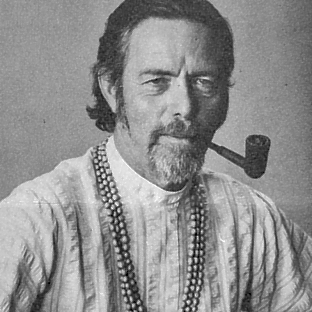
Embracing the Dance of Change
Alan Watts invites us to reconsider our relationship with change through his evocative assertion: "The only way to make sense out of change is to plunge into it, move with it, and join the dance." This perspective challenges the common human tendency to resist or fear transformation, urging us instead to embrace the fluidity of life. In a world characterized by constant flux, understanding how to navigate change becomes essential for personal growth and spiritual evolution.
Watts's words resonate deeply in our contemporary lives, where uncertainty often breeds anxiety. By framing change as a dance, he suggests that rather than standing on the sidelines, we should actively engage with the rhythms of life. This engagement not only fosters resilience but also cultivates a profound sense of acceptance and harmony with the universe. The stakes are high: to resist change is to resist life itself, while to join the dance is to open ourselves to the beauty and wisdom that emerge from the ever-shifting landscape of existence.
The image / the metaphor
The imagery of a dance is rich and multifaceted, evoking a sense of movement, grace, and spontaneity. To "plunge into" change suggests a bold, almost reckless abandon, a willingness to immerse oneself fully in the experience without hesitation. The verbs "move" and "join" imply an active participation, a dynamic interplay between the self and the surrounding world. This dance is not a solitary endeavor; it is a collective experience that invites us to connect with others and the environment, highlighting the interconnectedness of all beings.
Diving deeper into this metaphor, we can see that dance embodies the essence of life itself—an intricate choreography of joy, sorrow, chaos, and calm. Each step in the dance represents a moment of choice, a decision to either resist or flow with the music of existence. In this context, change becomes not an enemy to be fought but a partner to be embraced, inviting us to discover new rhythms and patterns that enrich our lives. The dance of change teaches us that life is not a linear path but a series of ebbs and flows, each moment an opportunity for transformation.
In the speaker's tradition
Alan Watts, a prominent figure in the popularization of Eastern philosophy in the West, draws heavily from Zen Buddhism and Taoism. Within these traditions, the concepts of impermanence and interdependence are foundational. The notion of dharma, or the natural order of the universe, aligns with Watts's call to engage with change, suggesting that by moving with the flow of life, we align ourselves with the greater cosmic dance. This idea resonates with the Zen principle of sunyata, or emptiness, which teaches that all things are transient and interconnected, urging us to let go of rigid attachments and embrace the fluid nature of reality.
A relevant text that echoes this sentiment is the Tao Te Ching, where Lao Tzu emphasizes the importance of yielding and adapting to the natural flow of life. He writes, "The wise adapt themselves to circumstances, as water molds itself to the pitcher." This wisdom parallels Watts's invitation to join the dance, reminding us that true strength lies in our ability to flow with change rather than resist it. By understanding our place within the larger tapestry of existence, we can cultivate a sense of peace and acceptance, even amidst uncertainty.
Living the teaching
Consider a modern scenario where this teaching can be applied: the experience of losing a job. In such a moment, the instinctive reaction may be one of panic and resistance, clinging to the familiar and fearing the unknown. However, by embracing Watts's invitation to "plunge into" this change, one might find new opportunities for growth and self-discovery. This could lead to exploring new career paths, developing new skills, or even pursuing long-held passions that had been set aside. The act of engaging with change transforms a potentially devastating experience into a fertile ground for renewal and creativity.
This teaching can also manifest in our relationships. When faced with conflict or change within a partnership, the tendency may be to resist or withdraw. Yet, by choosing to join the dance of dialogue and understanding, we open ourselves to deeper connection and healing. This requires vulnerability and a willingness to adapt, recognizing that relationships, like life, are not static but dynamic. By moving with the changes in our relationships, we cultivate a space for growth, intimacy, and mutual support, allowing love to flourish even in challenging times.
A reflection
As we contemplate Alan Watts's profound insight, we are invited to reflect on our own relationship with change. What areas of your life are you resisting, and how might you begin to "join the dance"? This question encourages us to explore the ways in which we can embrace the fluidity of existence, allowing ourselves to be swept up in the rhythms of life rather than standing apart. In this dance, we may discover not only the beauty of transformation but also the deeper truths of our interconnectedness with all that is.



Join the BrightStar Community
Stay connected with daily inspiration, event announcements, and community wisdom